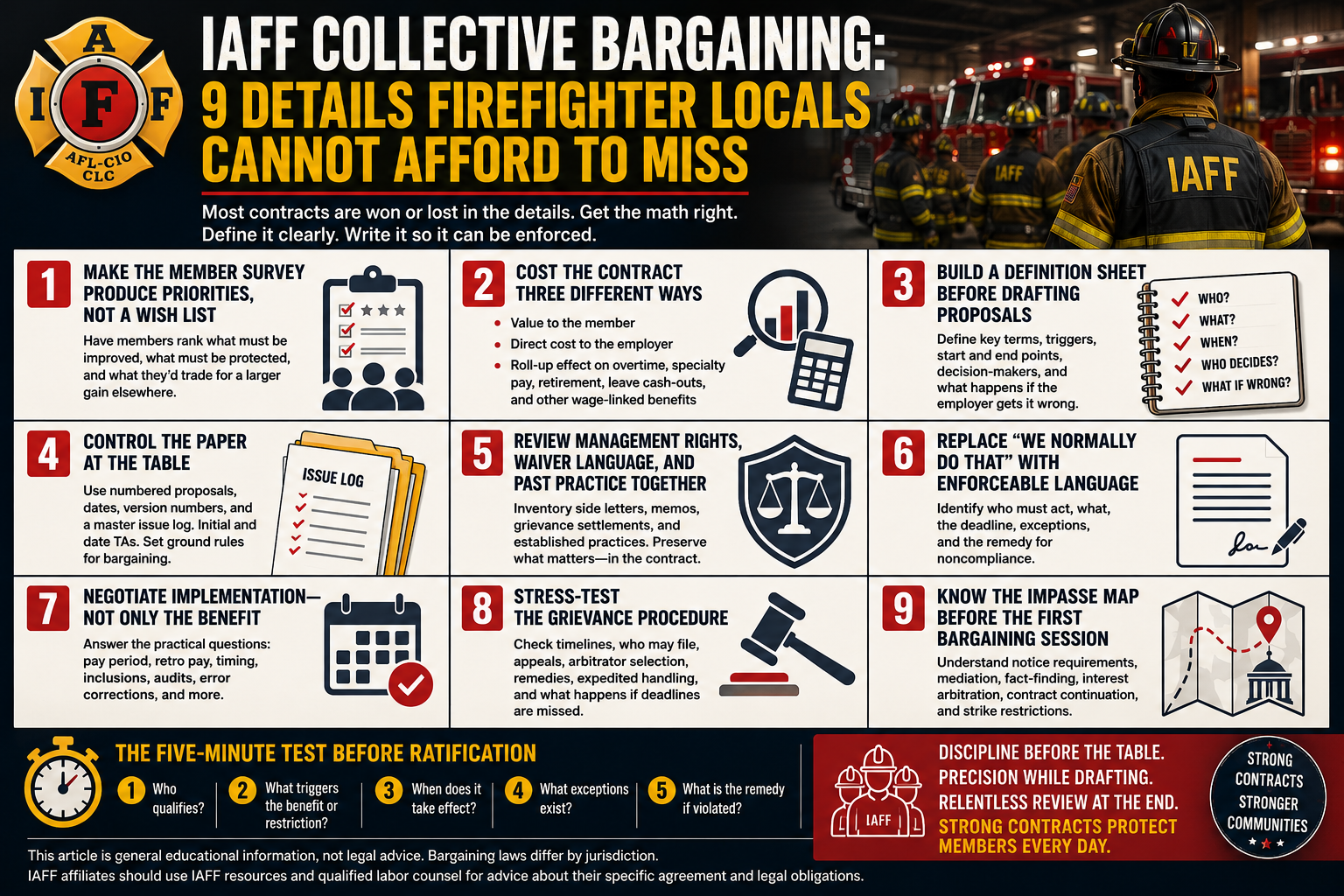
Most firefighter contracts are not won or lost on one dramatic proposal. Value is usually gained—or quietly given away—through math, definitions, and final language.
Laws and impasse procedures vary by state and province, but the preparation mistakes are remarkably similar. Here are nine overlooked IAFF collective bargaining tips that can make a real difference at the table and throughout the life of the contract.
1. Make the member survey produce priorities, not a wish list
A survey that asks, “What do you want?” will produce twenty number-one priorities. Make members rank what must be improved, what must be protected, and what they would trade for a larger gain elsewhere.
Break results down by classification, schedule, assignment, and years of service. A benefit that helps a senior firefighter may do little for a new hire, paramedic, dispatcher, or day-shift member. The IAFF Organizing Toolkit includes a bargaining survey affiliates can use as a starting point.
2. Cost the contract three different ways
Do not stop at base wages. For every economic proposal, calculate:
The value to the member
The direct cost to the employer
The “roll-up” effect on overtime, specialty pay, retirement contributions, leave cash-outs, and other wage-linked benefits
Compare total compensation using the same work year. Monthly salaries mislead when schedules, Kelly days, paid leave, healthcare contributions, deferred compensation, or annual hours differ. Compare budgets with actual revenue and spending too; a forecast alone does not tell the full story.
The IAFF treats proposal costing as a core bargaining skill and provides affiliates with model language and a contract library for comparison. Use comparables, but normalize the numbers before calling them comparable.
3. Build a definition sheet before drafting proposals
Words such as “emergency,” “vacancy,” “qualified,” “regular rate,” “callback,” “holdover,” and “acting” sound obvious until money or mandatory work is involved.
For every proposal, ask: Who is covered? What event triggers it? When does the benefit begin and end? Who decides whether the trigger occurred? What happens if the employer gets it wrong?
If two reasonable people can read a sentence and reach different answers, that sentence is a future grievance.
4. Control the paper at the table
Use numbered proposals, dates, version numbers, and one master issue log. Track current language, cost, related articles, tentative-agreement status, and unresolved questions.
Tentative agreements should be initialed, dated, and identified as conditional on the complete package and required ratification. Ground rules should address spokespersons, caucuses, records, bargaining authority, and member communication. IAFF negotiation training emphasizes ground rules and bargaining technique.
This sounds clerical. It is not. Poor document control creates expensive surprises.
5. Review management rights, waiver language, and past practice together
A broad management-rights clause combined with strong zipper or waiver language can weaken protections members have relied on for years.
Inventory side letters, memoranda, grievance settlements, established practices, and written interpretations. Decide which must be placed in the new agreement or expressly preserved. IAFF arbitration training notes that arbitrators may examine contract language, past practice, and the parties’ intent when resolving ambiguity.
6. Replace “we normally do that” with enforceable language
A promise at the table is not the same as a contractual obligation. Turn operational assurances into language that identifies:
Who must act
What must be done
The deadline
Any narrow exception
The remedy for noncompliance
This matters in mandatory overtime, callback lists, acting pay, leave approval, schedule changes, and vacancy filling. “The employer intends to” is weak. “The employer shall,” followed by a deadline and remedy, is enforceable.
7. Negotiate implementation—not only the benefit
A raise effective January 1 can still become a mess if the contract never says when payroll must implement it. Every major change should answer practical questions: Which pay period? When is retroactive pay due? Are separated or retired members included? How are step placements, leave banks, and schedule conversions handled? Who audits the calculation, and how are errors corrected?
Put the implementation calendar in the tentative agreement or a signed attachment. Do not leave it for payroll and management to “work out later.”
8. Stress-test the grievance procedure
The grievance article is the contract’s enforcement engine. Check when timelines begin, who may file, how deadlines may be extended, and whether a grievance can bypass a step when the decision-maker is already involved.
Also examine arbitrator selection, available remedies, expedited handling for payroll or safety disputes, and what happens when management misses a deadline. A strong benefit with a weak enforcement path is not fully protected.
9. Know the impasse map before the first bargaining session
Identify notice deadlines, mediation requirements, fact-finding options, interest-arbitration standards, contract-continuation rules, and strike restrictions before proposals are exchanged. The IAFF’s state-by-state collective bargaining overview shows how widely firefighter bargaining and impasse laws differ.
Where appropriate, a neutral mediator can help identify the interests underneath fixed positions. The Federal Mediation and Conciliation Service explains how mediation can address core bargaining issues.
The five-minute test before ratification
Before the bargaining team recommends a tentative agreement, take every important change and ask:
Who qualifies?
What exactly triggers the benefit or restriction?
When does it take effect?
What exceptions exist?
What is the remedy if the language is violated?
If the team cannot answer all five from the written agreement, the language is not finished.
The best IAFF collective bargaining teams are not simply aggressive at the table. They are disciplined before bargaining, precise while drafting, and relentless during final review. A percentage gets attention. Clear, enforceable language protects members for the entire contract.
This article is general educational information, not legal advice. Bargaining laws differ by jurisdiction. IAFF affiliates should use IAFF resources and qualified labor counsel for advice about their specific agreement and legal obligations.